

A Cruyff turn changes direction in one motion: the player shapes to pass or cross, drags the ball behind the standing leg, and turns away with it. Johan Cruyff put it in front of the world at the 1974 World Cup, in a match against Sweden. The move begins with one match in Dortmund and an idea called total football, and it runs through everything Johan Cruyff changed at Ajax, Barcelona and the Netherlands. He belongs in any honest ranking of the best soccer players of all time.
What is the Cruyff turn?
The Cruyff turn is a movement that sends the defender one way and the ball the other, built around a drag-back, which means pulling the ball back with the sole or the inside of the foot. The whole thing takes four movements, in this order:
- The body shapes as if to pass or cross.
- The foot goes to the far side of the ball instead of striking it.
- That foot drags the ball behind and across the standing leg with its inside.
- The player turns away the other way, the ball going with him.
When did Cruyff first do the Cruyff turn?
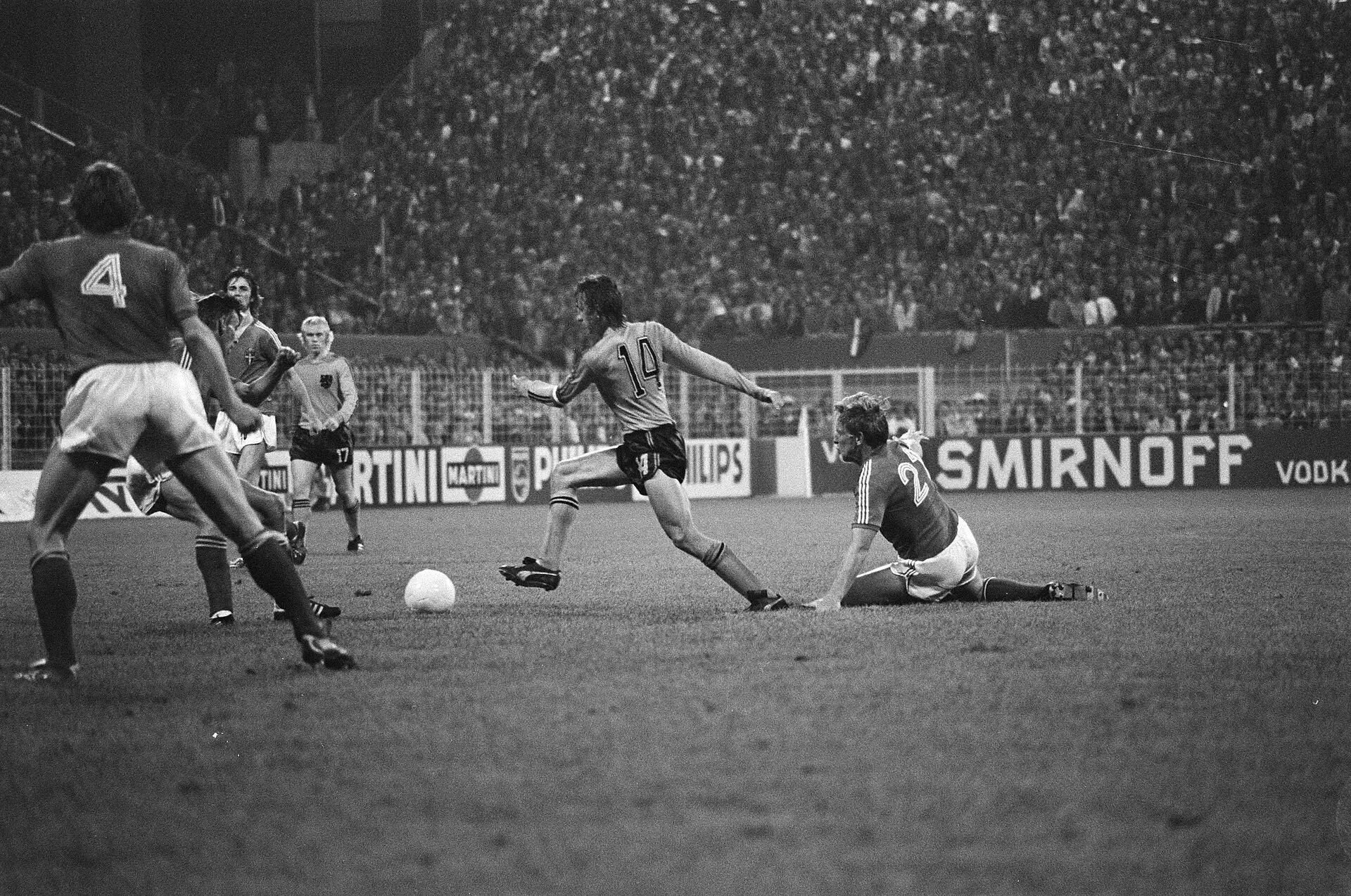
The world first saw the Cruyff turn on June 19, 1974, in a 0-0 group match between the Netherlands and Sweden at the Westfalenstadion in Dortmund, and the defender left behind was Sweden’s Jan Olsson.
- Cruyff shaped to pass, dragged the ball behind his standing leg, and was gone the other way.
- Olsson expected something else entirely: “I thought I was going to take the ball.”
- Years later, Olsson said, “I laughed then and I laugh now,” and added that he was proud to have been there.
The 1974 tournament and every other sit inside World Cup history and winners.
What is total football?
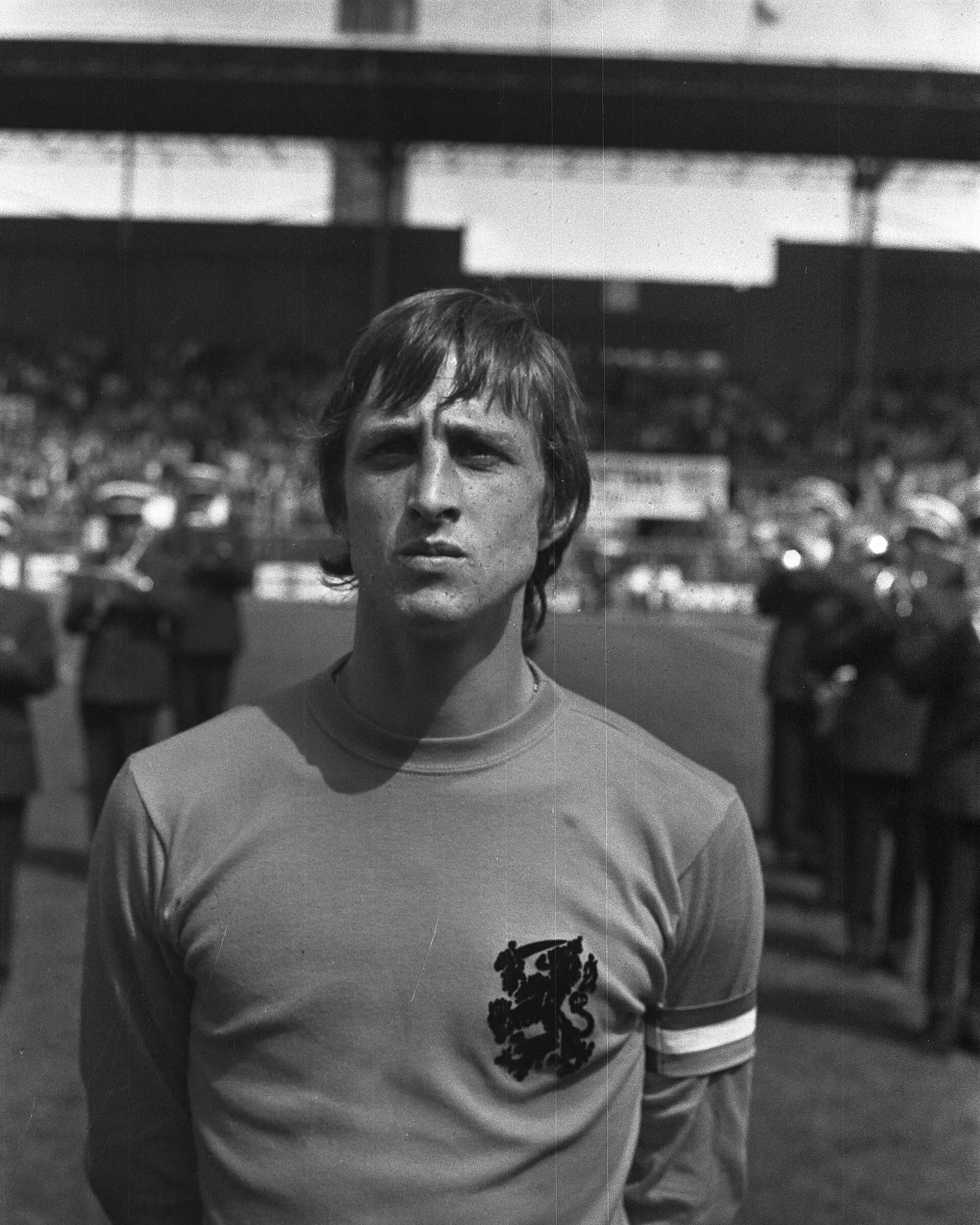
Total football is a way a team plays, not a fantasy game or a video game: the outfield players swap positions all match long, so the side’s shape holds while the people inside it move.
- Players interchange positions rather than staying in fixed roles.
- The team presses high up the field.
- Every outfield player joins the attack, full-backs included.
- Rinus Michels built it, coaching Ajax from January 1965 and leading the Netherlands at the 1974 World Cup, with Cruyff as his leading player.
A defender can finish a move at center forward, so knowing what every soccer position does helps you spot who has gone where.
What did Cruyff change at Ajax, Barcelona and the Netherlands?
Johan Cruyff carried one idea, the way of playing above, through Ajax, Barcelona and the Netherlands, first as a player and later as a coach. His Ajax debut came on November 15, 1964.
| Team | Years | What changed |
|---|---|---|
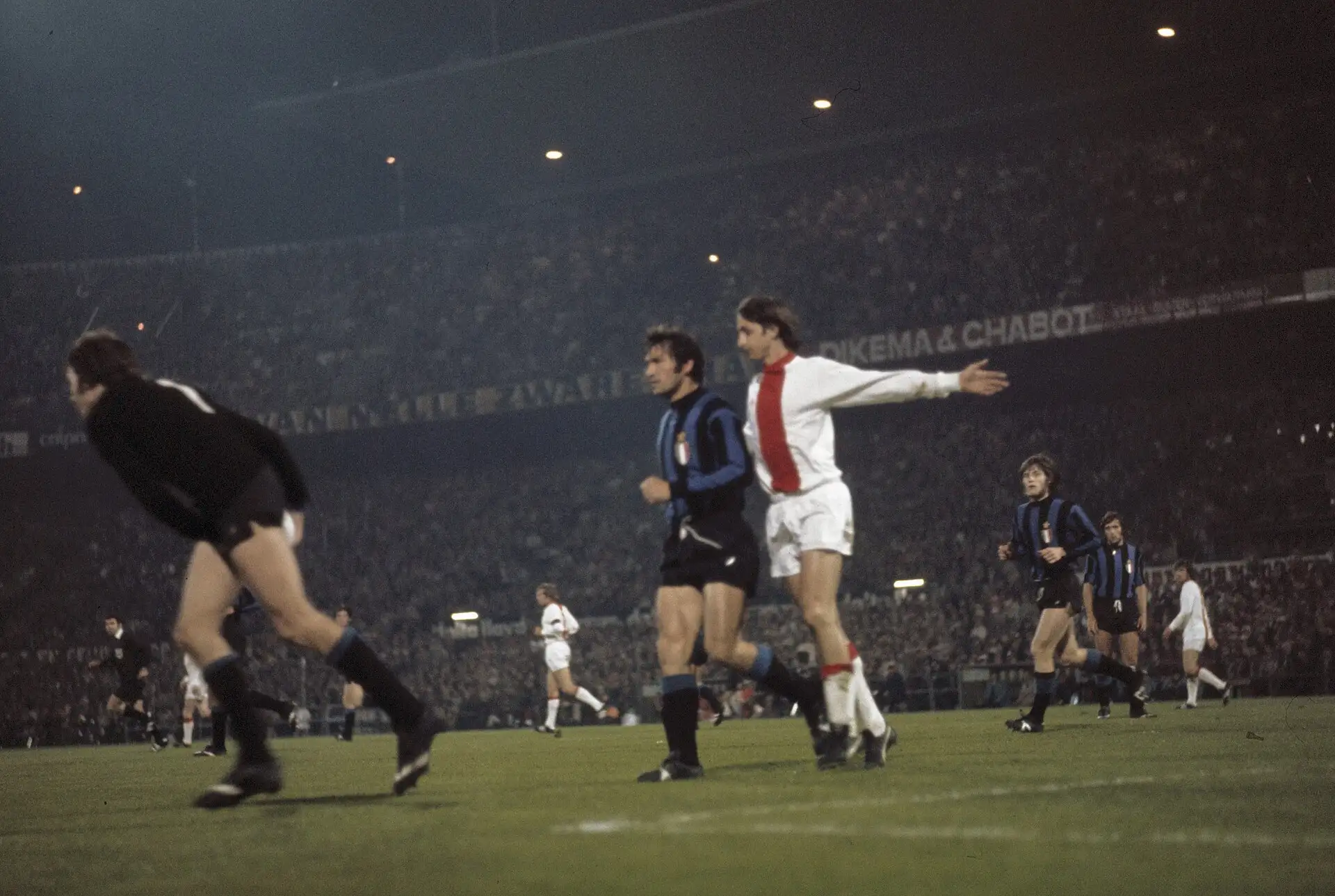
| Ajax | 1964-1973 | Three straight European Cups, 1971 to 1973, with two goals in the 1972 final, 2-0 against Inter |
| Netherlands | 1966-1977 | 48 caps and 33 goals; the 1974 World Cup final |
| Barcelona | 1973-1978 as a player, 1988-1996 as coach | The 1973-74 league title, the club’s first in 14 years; as coach, four straight league titles from 1991 to 1994 and the club’s first European Cup, 1-0 against Sampdoria at Wembley on May 20, 1992 |
Individually, he won the Ballon d’Or in 1971, 1973 and 1974. One trophy stayed out of reach.
Why did Johan Cruyff never win a World Cup?
Johan Cruyff never won a World Cup: West Germany beat the Netherlands in the 1974 final, and in the 1978 final, without him, they lost 3-1 to Argentina after extra time. The final took place at Munich’s Olympiastadion on July 7, 1974, where Uli Hoeness brought Cruyff down in the first minute and Johan Neeskens scored the penalty before any German touched the ball, still the fastest World Cup final goal. Paul Breitner equalized from a penalty; Gerd Muller won it 2-1. Cruyff had retired internationally in 1977, and in April 2008 he told a Barcelona radio station that an attempt to kidnap him at his Barcelona flat at the end of 1977 was why he did not go. The greatness argument starts with that missing medal; what he left behind ends it.
Why does the Cruyff turn still matter?
Fifty years on, the Cruyff turn still beats defenders with the body and the timing rather than speed.
- Young players still learn the turn in training.
- Pep Guardiola played in midfield for Cruyff’s Barcelona and coached the club from 2008 to 2012, winning the Champions League in 2009 and 2011.
- The name is still attached to the move all these years after Dortmund; Cruyff died in Barcelona on March 24, 2016.
To weigh his claim against the other greats, read every era judged.
Did Cruyff invent the Cruyff turn?
The short answer
Is the Cruyff turn hard to do?
The short answer


